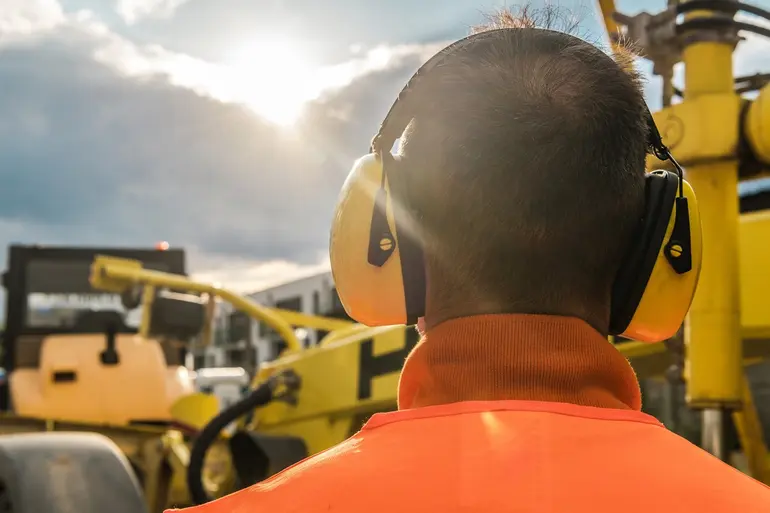
Invisible Dangers: Noise on Construction Sites
When Noise Becomes a Risk
On a construction site, noise is part of everyday life. Hammers, saws, drills, compressors, heavy machinery… There are many sources of noise, and over time, it can become so commonplace that we stop seeing it as a hazard.
However, A noisy environment can have very real consequences for workers' health and safety. And unlike a fall or an injury, the effects of noise can be gradual and difficult to notice until it's too late.
A danger you can't see
Noise is one of the invisible hazards on construction sites because it does not necessarily leave any immediate trace.
A worker may finish the day without any pain or apparent injury, even though he or she has been exposed to high noise levels for several hours. When repeated day after day, this exposure can contribute to a gradual decline in hearing.
That's exactly where the problem lies: Noise-induced hearing loss can develop gradually. It may start with difficulty understanding a conversation in a noisy environment, hearing certain sounds, or clearly making out the voices of coworkers.
And by the time symptoms become apparent, the damage may already be significant.
How can you tell if the noise at a construction site is too loud?
You don't always need to have a measuring device on hand to recognize certain situations that give cause for concern.
Here are a few clues that should catch your attention:
- You must raise one's voice to talk to a coworker who is nearby.
- Do you have a feeling that your ears are blocked, or a ringing in the ears after work.
- Do you have trouble understanding conversations in noisy environments?
- Noise makes you feel tired or irritable.
- Some equipment produces noise loud enough to make communication difficult.
Of course, these signs are no substitute for a noise level measurement, but they may indicate that it is time to consider exposure and the preventive measures in place.
The danger isn't limited to hearing
When we talk about noise in construction, we automatically think of occupational hearing loss. It is indeed a major issue, but Noise on a construction site can also affect the safety of operations.
On a construction site, communication is essential.
A worker who cannot clearly hear an instruction, a warning signal, or the sound of approaching machinery may be at greater risk of an accident.
Noise can also contribute to fatigue and impair concentration. In an environment where workers must constantly be aware of their surroundings, equipment, and the movements of their coworkers, this decline in attention should not be overlooked.
Noise can therefore become a secondary risk that exacerbates other hazards already present on the construction site.
Hearing protection: part of the solution
When noise exposure cannot be sufficiently reduced at the source, wearing appropriate hearing protection becomes essential.
Depending on the situation, different types of protective gear can be used, including:
- earplugs;
- earplugs;
- a combination of the two in certain particularly noisy situations.
But providing hearing protection isn't enough. It must be appropriate for the noise level, used correctly, and worn at all times during periods of exposure.
A hearing protector left around the neck while noisy equipment is operating nearby obviously does not protect your hearing.
Reducing Noise at the Source
However, prevention should not rely solely on personal protective equipment.
When it is possible to reduce noise directly at the source, this approach should be prioritized.
This can be achieved, for example, through:
- regular maintenance of equipment;
- choosing quieter equipment whenever possible;
- the use of sound barriers or acoustic insulation;
- keeping workers away from noise sources;
- reducing exposure time;
- scheduling particularly noisy work.
The goal is simple: Minimize noise as much as possible before having to rely on personal protective equipment.
A risk that deserves our attention
On a construction site, the most obvious hazards naturally catch our attention. We think of falls, moving equipment, electrical hazards, and hazardous materials.
But some risks are much more subtle.
Noise is part of it.
Because it is a daily occurrence, it may eventually come to be seen as “normal.” However, Just because a danger is common does not mean it is without consequences.
Taking a few minutes to identify sources of noise, assess your exposure, and ensure that hearing protection is being used properly can make a real difference in the long run.